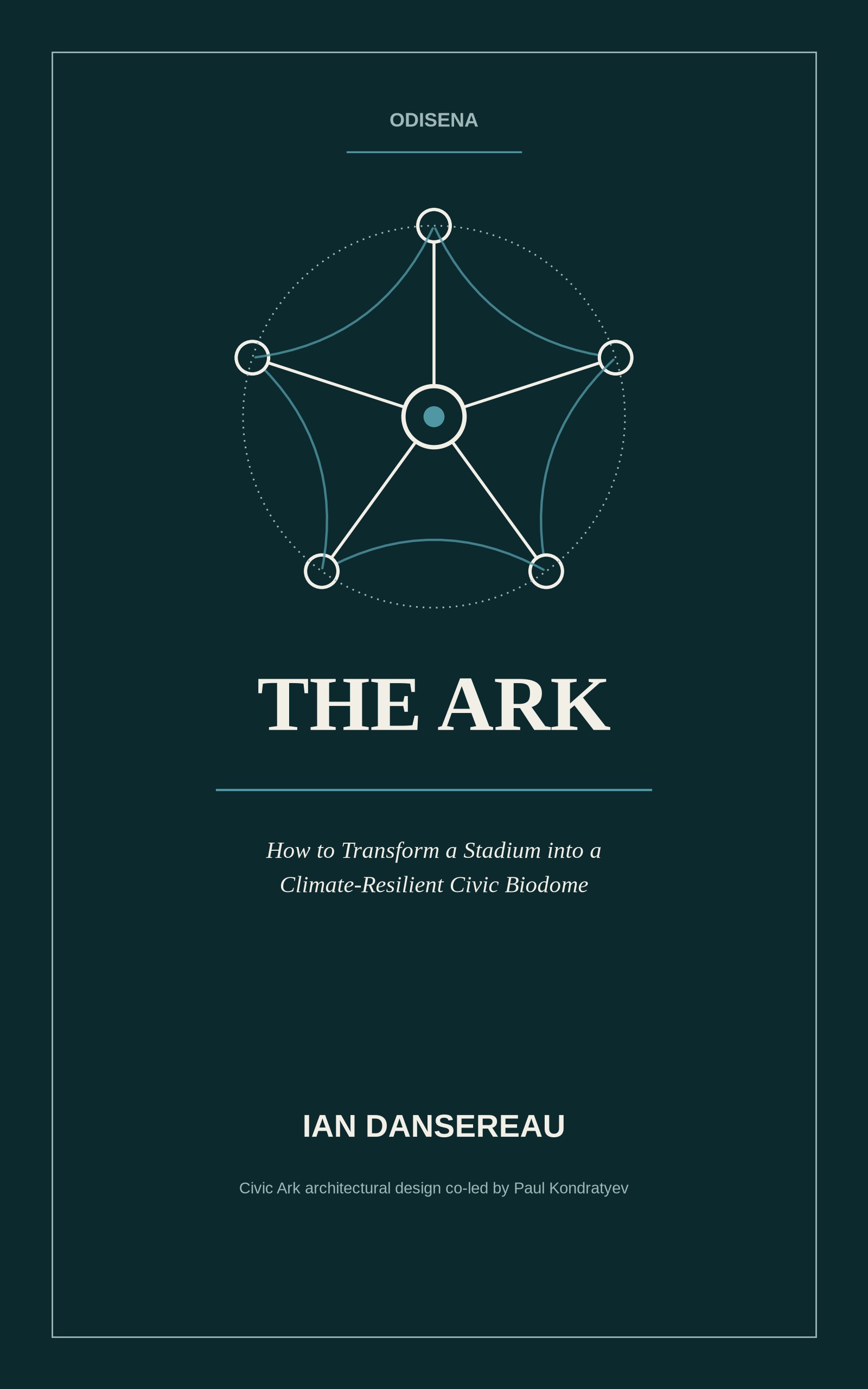
Five loops that must keep closing
Protected space & safe intake
Protected space and the intake process that fills it safely — the door people enter with dignity.
Potable supply, hygiene & sanitation
Drinking water, washing, and working toilets within a short walk — with wastewater treated as the loop's downstream half.
Nourishment, honestly framed
Meals shared rather than rations received — framed as supplementary and cultural, never as caloric self-sufficiency.
Generation, storage & islanding
Solar, batteries, and a microgrid that can island critical loads — resilience measured as time held open, not guaranteed power.
Care, infection control & governance
Medical care, infection control, security, and the incident command and resident governance that keep a crowd a community.
Three cross-cutting loops — air, waste, and coordination — run through every primary loop rather than sitting beside them. The Ark's true capacity is never its floor area; it is the minimum across all the loops of the number each can sustain for the stated duration. The weakest loop sets the capacity.
A complete way of thinking, with the tools to begin
- The five-loop framework and three cross-cutting operational loops
- A four-phase activation lifecycle: normal, forecast, crisis, relief
- A resource-machine roof described on a confidence ladder — proven, conditional, experimental, speculative
- Capacity treated as hypotheses forced through constraint gates, never as certified figures
- Original systems diagrams, decision gates, estimating frameworks, and checklists
- A full risk register of claims the book must not overstate
- Numbered notes tying every factual claim to a fetched source
- 12 original informational schematics, 15 tables, and 15 design-gate / claim-control callouts
I will not print a number I cannot stand behind.
Codes, guidelines, recommendations, case facts, and Odisena planning scenarios are distinguished throughout. Where the evidence base could not confirm a figure, the book marks it to be sourced rather than filling it from memory. The Ark is kept open and utility-interconnected — never a sealed, self-sufficient biosphere.
Conceptual — not for construction. This is a concept blueprint and implementation framework, not a set of construction documents, an engineering certification, an emergency-management directive, or a guarantee. Any real Ark must be led and independently verified by licensed professionals and shaped by the community it serves.
Written for the people who could actually build an Ark
Expert but readable, and written to be held to its own standard.
Secondary readership: graduate students and researchers in resilience, adaptive reuse, and disaster management, and informed general readers interested in climate adaptation. Non-fiction, professional; not a children's or low-content title.
24 chapters across five parts
Plus front matter (foreword, preface, introduction, about-this-edition) and back matter (conclusion, glossary, implementation checklists, a design-gate reference, a claim-control reference, and comprehensive source notes). Approximately 90,000 words; 259-page 6×9 print interior.
The Thesis and the Framework
The Loops in Depth
The People
Hazards, Phases, and Operations
Money, Verification, and Delivery
Introduction: A Promise a Community Keeps to Itself
“A shelter is not a building. It is a promise that a community keeps to itself.” — Author's note
Picture the day after. A hurricane has passed, or a wildfire has choked the sky, or a flood has taken the low neighborhoods, and tens of thousands of people need somewhere to be that is safe, dry, powered, watered, and organized. In most cities, the answer is improvised: school gymnasiums, convention halls, whatever can be opened and staffed in a hurry. The improvisation often works, and the people who run it are heroes. But improvisation has limits, and those limits are measured in the gap between what a shelter can provide and what its occupants need — the gap where illness spreads, where the vulnerable are stranded, where the water runs short and the tempers run high.
This book is about closing that gap deliberately, in advance, using a building the city already owns and already loves. A World Cup-scale stadium is, on the day after, the most capable structure most regions have: vast, well-served, sturdy, and connected. The Ark is the discipline of preparing that structure so that its second job — crisis shelter, civic relief hub, culture-centered resilience venue — is designed rather than improvised, tested rather than hoped for, and honest rather than oversold.
What you will find in this book
You will find a framework of five primary loops — shelter, water, food, energy, and health/order — with three cross-cutting operational loops of air, waste, and coordination running through them. You will find a four-phase activation lifecycle that keeps the building useful on ordinary days and safe on the worst ones. You will find a resource-machine roof described with a confidence ladder that separates the proven from the speculative. You will find capacity hypotheses treated as hypotheses, forced through a funnel of constraint gates before they can become a planning number. You will find original tables, checklists, estimating frameworks, decision trees, and clean schematic diagrams, every one of them labeled conceptual and not for construction. And you will find, at the end of every chapter, the numbered notes that tie each claim to its source.
What you will not find
You will not find a sealed, self-sufficient biosphere; the historical record forbids it. You will not find a promise that the Ark can feed its population from its own gardens; the energetics forbid it. You will not find rainwater or fog described as drinkable from the roof; the pollutant record forbids it. You will not find a microgrid described as a guarantee of uninterrupted power, a PPP described as inherently superior procurement, or a capacity figure described as certified. And you will not find a number filled in from memory where the evidence base could not confirm it; you will find, instead, an honest note that the figure must be sourced before publication. These absences are not gaps in the book. They are the book.
A book that practices what it preaches
The book aspires to practice the discipline it preaches. Its claims are cited to fetched evidence; its overstatements are refused in an explicit register; its uncertain figures are marked to-be-sourced rather than invented; its diagrams are labeled conceptual and not for construction and designed to remain legible in grayscale. The Ark is a concept blueprint and an implementation framework, not a set of construction documents, an engineering certification, an emergency-management directive, or a guarantee. Any real Ark must be led and independently verified by licensed professionals and shaped by the community it serves. With that understood, turn the page and begin with the thesis: why the stadium, of all buildings, is the one worth preparing.
Excerpt from the introduction of The Ark, © 2026 Ian Dansereau. The complete text is available in the free EPUB and PDF editions above.
Editions
The first edition is published by Odisena. The digital editions — reflowable EPUB and digital PDF — are complete, free public downloads. The paperback and hardcover are fully prepared and KDP-ready; their Amazon listing is the only remaining step, so the Amazon calls to action below stay in a coming-soon state. When each listing goes live, its final product link can be inserted in one configuration location (see page source: window.ARK_AMAZON).
Reflowable EPUB 3
Illustrated, navigable, with accessible headings and alt text. The complete book as a free public download.
Digital PDF edition
The complete book as a fixed-layout digital PDF — the full 259-page interior, fonts embedded, for reading on any device or desktop.
6×9 paperback
259-page black-ink print interior, fonts embedded, mirrored margins. Fully prepared and KDP-ready; Amazon publication is pending and it is not yet orderable.
6×9 hardcover
261-page case-binding print interior. Fully prepared and KDP-ready; Amazon publication is pending and it is not yet orderable.
Publication details
- Title
- The Ark
- Subtitle
- How to Transform a Stadium into a Climate-Resilient Civic Biodome
- Author
- Ian Dansereau
- Contributor
- Paul Kondratyev — Designer (Civic Ark architectural design co-led by Paul Kondratyev)
- Publisher / Imprint
- Odisena
- Edition
- First edition · 2026
- Extent
- ≈90,000 words · 24 chapters in 5 parts · 259-page 6×9 print interior
- Language
- English
- Categories
- Architecture · Civil Engineering · Disasters & Disaster Relief · Climate Adaptation
- Digital editions
- Reflowable EPUB 3 and digital PDF — free public downloads
- Print editions
- 6×9 paperback and hardcover — fully prepared and KDP-ready; Amazon publication pending
- ISBN
- To be assigned on Amazon KDP publication of the print editions
- Status
- Published by Odisena (first edition, 2026); Amazon KDP listing is the only pending channel
This edition includes AI-generated text and AI-generated diagrams and cover artwork, produced with the assistance of generative tools under human editorial direction and review. The interior schematic diagrams and the cover artwork are AI-generated informational graphics; the manuscript text was generated with AI assistance and edited by a human. The ideas, framework, partnership, and responsibility are human.
A partnership with a clean division of authority.
Civic Ark architectural design is co-led by Paul Kondratyev. Paul Kondratyev and Ian Dansereau are equal co-lead designers of the Civic Ark venture and hold 50/50 ownership of the venture and its design intellectual property. Within the partnership, Paul Kondratyev holds final decision authority over architecture and visual design, and Ian Dansereau holds final decision authority over systems and infrastructure. This book is authored by Ian Dansereau and presents the systems-and-infrastructure framework; it does not assert that any single individual solely owns or created the Civic Ark design, and its schematic diagrams are systems diagrams that do not depict or stand in for the architecture Paul leads.
The Ark is © 2026 Ian Dansereau, published by Odisena. This page makes no claim of certified capacity, self-sufficiency, engineering approval, publication availability, or partner sign-off. Conceptual — not for construction.