Chapter 15 · Part III — AVPT: The Cycle That Grows the System
The AVPT Gate
#Opening signal
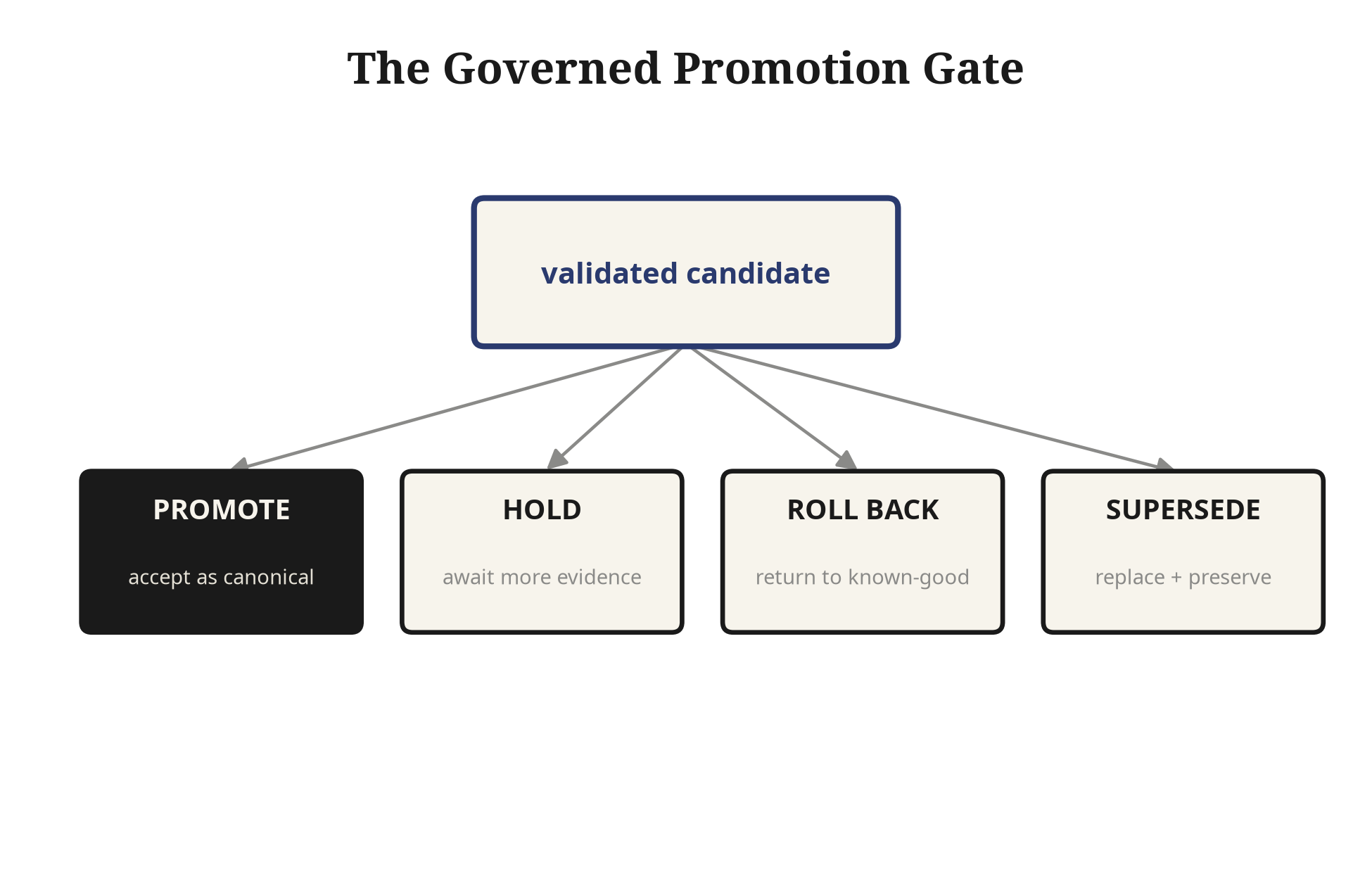
A candidate has been attempted, has passed validation, has been preserved with its provenance, and is tracked in the ledger. Now comes the decision that the entire cycle exists to make: does this candidate become the canonical next state? It is tempting to say "of course — it passed validation." But promotion is a separate act from validation, and keeping it separate is what makes governed growth possible. The gate is the single controlled point where a validated candidate is promoted to canonical, held for more evidence, rolled back, or superseded. Four outcomes, one gate, one place where the decision is made and recorded.
#Mathematical core
FACT. Even in pure mathematics, "computed" and "accepted as canonical" can differ. Consider building a verified table of Fibonacci numbers for use as a reference. A candidate term is computed (Attempt), checked against the recurrence and Cassini's identity (Validate), and stored with its derivation (Preserve, Track). But it becomes part of the canonical reference table only when it clears the gate — which might require, say, agreement between two independent methods. If the two methods disagree, the candidate is not promoted; it is held until the discrepancy is resolved. If a previously-accepted term is later found wrong (an earlier error propagated), it is superseded — the table advances to a corrected version, and the erroneous entry is preserved, marked, and pointed to its replacement. The gate has four outcomes because growth has four situations: good candidate (promote), uncertain candidate (hold), bad candidate (roll back), and a good candidate that replaces a flawed predecessor (supersede).
#Odisena translation
CANON. The AVPT gate is the single controlled promotion point with exactly four outcomes: promote (accept as canonical), hold (retain as candidate pending more evidence), roll back (reject and return to the last known-good state), and supersede (accept while explicitly replacing and preserving a flawed predecessor). Only validated candidates reach the gate; passing validation is necessary but not sufficient for promotion.
METHOD. Make promotion an explicit, recorded decision distinct from validation, with the four outcomes and a required evidence bundle for each. Bound the authorization: who or what is allowed to promote, and within what scope? The Odisena deployment work enforces exactly this separation — production promotion is kept distinct from code merge, and remained fail-closed (production disabled) until the required preservation infrastructure, roles, and evidence existed, so that "the code is merged and validated" never automatically became "the change is live in production."[40][41] Merge is validation; promotion is a separate, governed, bounded decision.
#Boundary note
INTERPRETATION. The instinct to collapse the gate — "if it passed validation, just ship it" — is strong and, for low-stakes reversible changes, sometimes correct. My interpretation: the gate's value scales with the cost of being wrong and the difficulty of reversal. For a trivially reversible change, a heavyweight four-outcome gate is waste. For an irreversible or high-blast-radius change, collapsing the gate is how disasters happen. The mature practice is not "always gate heavily" but "size the gate to the stakes," and — critically — never let promotion of an irreversible change be automatic simply because validation passed.
#Applied CASE
CASE. Consider the "supersede" outcome, the subtlest of the four. A canonical artifact — a model configuration, a doctrine file — is found to contain a flawed element. The wrong move is to edit it in place. The governed move is supersession: a new version is created, the specific flawed element is replaced, everything else is carried forward unchanged, and the predecessor is preserved and marked superseded rather than deleted. The Odisena supersession discipline does exactly this: when one clause of a versioned file needed to change, the file was not edited; a supersession note was attached alongside it, the single affected clause was marked, the correction was carried into the next full regeneration, and the prior version remained on disk, marked superseded, never deleted.[42] The gate's "supersede" outcome is what makes correction compatible with preservation.
#Failure mode
The failure mode is the collapsed gate: promotion happening automatically on validation, with no separate decision, no bounded authorization, and no supersession discipline. Its most dangerous form is auto-promotion of irreversible changes — the moment validation passes, the change is live and cannot be undone, so a validation gap becomes an unrecoverable production state. A second form is the silent supersession, where a flawed canonical state is edited in place instead of being explicitly replaced-and-preserved, destroying the record of the correction. The fix is to separate promotion from validation, bound the authorization, size the gate to the stakes, and make supersession explicit.
#Reusable protocol — The Promotion Gate
At the single promotion point, for every validated candidate, decide and record one of four outcomes:
- Promote — accept as canonical. Record: validation evidence, the promoting authority, the scope.
- Hold — retain as candidate pending more evidence. Record: what evidence is missing and what would clear it.
- Roll back — reject; return to the last known-good state. Record: why, and confirm the known-good state is restored.
- Supersede — accept while replacing a flawed predecessor. Record: what is replaced, why, and confirm the predecessor is preserved and marked, not deleted.
- Bounded authorization — confirm the deciding authority is permitted to promote at this scope, and size the gate's weight to the cost of being wrong and the difficulty of reversal.
#Validation questions
- Is promotion in your system a separate decision from validation, or does passing validation ship the change automatically?
- Do you have all four outcomes available — including "supersede" done as replace-and-preserve rather than edit-in-place?
- Is the authorization to promote bounded by scope, or can any passing candidate be promoted by anyone?
- Which of your changes are auto-promoted despite being irreversible?
#Sizing the gate: a spectrum, not a switch
INTERPRETATION. The hardest judgment in all of governed growth is how heavy to make the gate, and getting it wrong in either direction is costly. Too heavy, and every trivial change drowns in ceremony, the team routes around the gate, and governance becomes something people evade rather than use. Too light, and a consequential, irreversible change slips through on the same easy path as a cosmetic one, and a validation gap becomes a disaster. The resolution is to treat the gate's weight as a spectrum indexed by two variables: the cost of being wrong, and the difficulty of reversal. A change that is cheap to get wrong and trivial to reverse deserves a feather-light gate — perhaps just automated validation and an automatic promote. A change that is expensive to get wrong and impossible to reverse deserves the full apparatus: independent validation, a human decision, a bounded authorization, and a preserved record. Most changes fall between, and the skill is calibrating the gate to the change rather than applying one weight to all.
The most important line on this spectrum is the irreversibility line. Below it, mistakes are recoverable, and you can afford to be fast, because the reader's engine will catch and roll back errors. Above it — for the truly irreversible actions, the ones that cannot be undone once taken — speed is a false economy, because there is no rollback to save you, and the only protection is the gate itself. My strongest operational conviction in this whole book is this: never let an irreversible change be auto-promoted on validation alone. Validation tells you the change passed the checks you thought to run; it cannot tell you about the errors you did not anticipate, and for a reversible change that residual risk is bounded by your ability to roll back. For an irreversible change it is unbounded. The gate, with a human at it, is the only thing standing between a validation gap and a permanent mistake.
#The four outcomes are exhaustive, and that is the point
INTERPRETATION. It is worth dwelling on why the gate has exactly four outcomes and not three or five, because the completeness of the set is what makes the gate trustworthy. Every validated candidate is in one of exactly four situations. Either it is good and should become canonical (promote); or it is not yet known to be good enough and needs more evidence before a decision (hold); or it is bad and the system should return to its last known-good state (roll back); or it is good and it replaces something that was canonical and is now known to be flawed (supersede). There is no fifth situation, and there is no situation these four fail to cover. This exhaustiveness matters because a gate with missing outcomes forces real situations into the wrong box: a gate with no "hold" outcome forces uncertain candidates to be either promoted (accepting unvalidated states) or rolled back (discarding possibly-good work), when the honest answer is "we do not yet know." A gate with no "supersede" outcome forces corrections to masquerade as ordinary promotions, losing the crucial record that a predecessor was replaced. The four outcomes are exhaustive so that every real situation has a correct box, and no situation is forced into a lie.
The outcome that teams most often omit is "hold," and its omission is quietly corrosive. "Hold" is the outcome that says "we do not yet know enough to decide," and it is uncomfortable because it defers a decision and leaves a candidate in limbo. But the discomfort is precisely its value: a system without a "hold" outcome cannot represent uncertainty, and a system that cannot represent uncertainty will resolve every uncertainty prematurely, in one direction or the other, usually toward promotion because promotion feels like progress. The "hold" outcome is the institutional permission to say "not yet," and the presence of that permission is what prevents the gate from degrading into a rubber stamp. A mature gate uses "hold" often, because genuine uncertainty is common, and a gate that never holds is a gate that has quietly decided uncertainty does not exist — which is the most dangerous certainty of all.
#Bridge
Part III is complete. RFPA framed the system; AVPT grew it, one validated, preserved, tracked, gated state at a time. But a single well-run cycle is not yet the Infinity Engine. The engine is what happens when you run these cycles repeatedly and under governance — many turns, each preserving evidence, none uncontrolled, none literally endless. Part IV assembles the frame and the cycle into the governed recursion that is the heart of this book.